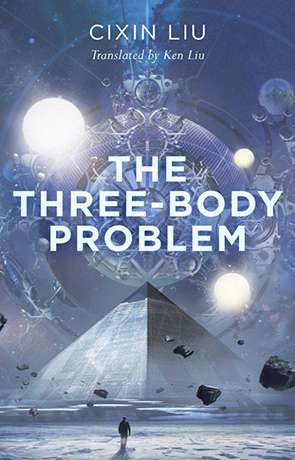
Title: The Three Body Problem
Author: Liu Cixin
Translator: Ken Liu
Publisher: Chongqing Publishing Group
Publication Date: 2008
I first became aware of the story that is The Three Body Problem through the Netflix adaptation of the same name. I really enjoyed the series but heard that it was a ‘westernised’ version Liu Cixin’s original work. I was excited to read the novel and find out how the story was originally told.
The plot moves around through different locations and time periods but it can essentially be divided into two storylines – past and present. Starting in 1967 during China’s Cultural Revolution we trace Ye Wenjie’s difficult journey from scientist’s daughter to outcast to working at Red Coast Base and their secret project to send a message to the stars. It succeeds – only the response is far from friendly. In the present Wang Miao experiences the consequences of Red Coast’s actions, although he doesn’t know it at first. Miao’s storyline is split between helping the military gain more information about these aliens and playing an immersive video game that invites players to solved the ‘Three Body Problem’. In terms of the novel this relates to the seemingly impossible task of predicting the orbit of three suns in order to save the planet trapped between them.
Throughout the book but particularly within the past storyline, the pages are dotted with translator Ken Liu’s footnotes. My knowledge of Chinese history is very limited so these notes, which added context to what I was reading about, I found incredibly helpful. I definitely felt as though I was learning whilst I was reading and the notes gave me a greater appreciation for Liu Cixin’s work.
One thing that did confuse me was the decision to advertise this book as Miao’s story. As this book is the first in a trilogy I’m guessing his story will be expanded upon later on but for The Three Body Problem I’d estimate that at least half the book recounts Wenjie’s story and a large part of the remaining story takes place in the virtual world. While we do follow these chapters through Miao’s eyes he is always in his virtual avatar form discussing scientific theories. This leaves a surprising short amount of the book’s 420+ page count set in the present day where Miao can have an impact on the real world. And even more oddly the book seems to forgot that Miao has a wife and son as they disappear completely after a few chapters and are never mentioned again. With Wenjie as either the driving force or the linchpin for everything that happens in the book I would definitely label her as the main character rather than Miao who often feels like a guest in her story rather than the other way around.
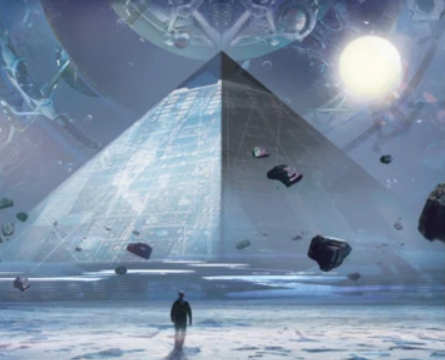
The Three Body Problem is filled with scientific theories and problem solving, leading to this book being referred to as ‘hard science fiction’. I know a lot of the science in the book is beyond my understanding to grasp completely but I was nevertheless able to understand enough to follow along with the story. I found myself rereading several of these science-heavy sections out of a desire to learn and to better try to understand the concepts I was being introduced to. Normally I dislike books where I find myself having to reread pages but in this case I genuinely enjoyed the experience that The Three Body Problem offered me.
It’s true that Netflix did indeed ‘westernise’ the story. The present day storyline is vastly different with Miao’s role being split between several new characters and the primary location is moved from China to the United Kingdom. However, whilst I was reading, I was both pleased and relieved to find that Wenjie’s story and the video game interactions did owe their originals to Liu Cixin’s work – albeit with the book offering a lot more detail.
I had a great experience reading The Three Body Problem. The story kept me both interested and wanting to learn more. I loved all of the historical references included in the book and how it challenged and expanded my knowledge of scientific concepts. I don’t often read science fiction books so heavily rooted in the science aspect of the genre but I’m really glad I had the opportunity to read this book.
Related Posts:
If you enjoyed this review you may also like these reviews: