
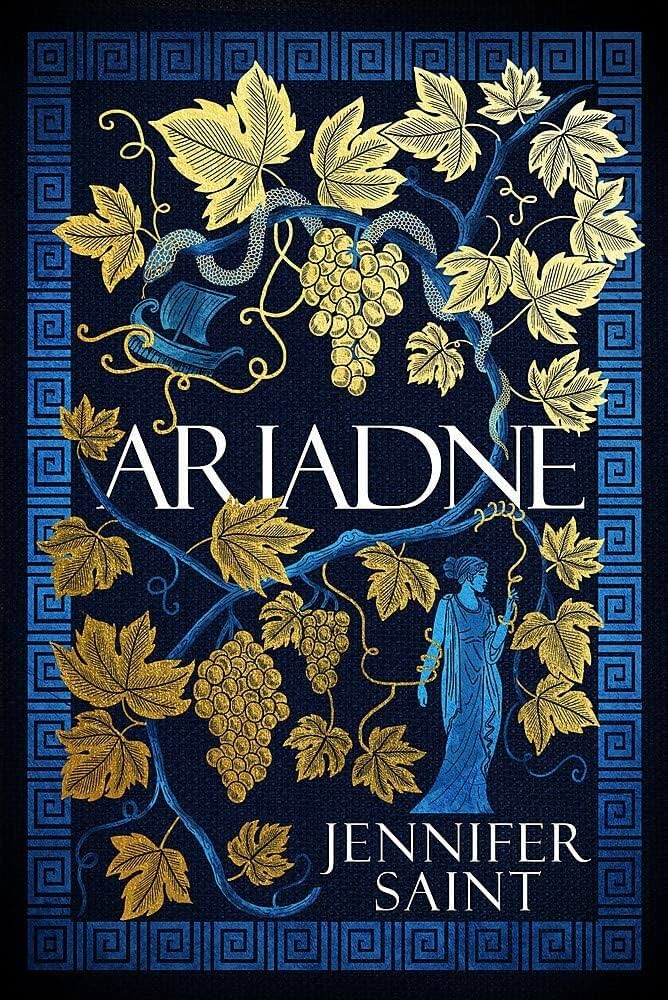
Title: Ariadne
Author: Jennifer Saint
Publisher: Wildfire / Headline Publishing Group
Publication Date: 2021
Ariadne by Jennifer Saint is a retelling of the classic Greek myth: Theseus and the Minotaur. Despite the popularity of the sub-genre, this is my first time reading either a historical or mythological retelling.
Prior to reading the book, all I knew about Ariadne’s story was her well-known connection to Theseus as she gifts him the string which helps him navigate the labyrinth.
At the end of the book Saint explains that she researched and collected multiple references to Ariadne, then put them together in a way that made narrative sense. She then added her own embellishments and additions to help create a cohesive and entertaining story.
In Saint’s version of Ariadne’s tale we see a young princess with a kind heart, trapped by both the limits society places on women and her own father’s cruelty. The king’s ambition and hunger for power sees an increasing amount of dislike towards the royal family of Crete. Then comes the arrival of the Minotaur, Ariadne’s brother whom Poseidon created to humble King Minos. After Theseus has completed his mythological duty and stain the beast, the story shifts. Ariadne escapes Crete only to find herself cast aside and abandoned on the island of Naxos. Once there despair turns to amazement as she leads a life far different to anything she imagined as a child.
Considering it is the most widely-known part of her story, I was surprised by how quickly the novel moved through scenes of the Minotaur and the labyrinth. Although in hindsight, perhaps this popularity is the very reason why Saint chose to move so speedily through this section. With fewer places to add to the story without making significant changes to established mythology, it is possible that Saint wanted to bring to her readers newer details of Ariadne’s time on Naxos and her younger sister Phaedra’s life in Athens. Certainly these parts of the book were completely fresh to me.

The sisterly bond and the connection shared between one woman and other are some of the key themes within the novel. The sisters are deeply devoted to each other and share the same fearful feelings towards their father. They both dream of a life beyond Crete, although neither is prepared for the hand life deals them. In a bond that is severely tested by the distance of the ocean and the passage of time, the connection between these characters and the changing feelings they have towards each other was one of the strongest parts of the novel.
An understandable consequence of the novel is that, because we see the world solely through Ariadne’s and later Phaedra’s eyes, we miss out of learning certain details because our characters never learn them. I was really curious about what happened to the emotionally and mentally fragile Queen Pasiphae after her two daughters left home. Did she ever recover or did she continue to drift away? And why would a cruel and power-hungry tyrant such as King Minos so willing give up his throne and the empire he had carved to hunt silently and alone for the escaped Daedalus for years? Was it just madness that consumed him or something else?
Without really knowing what to expect from a mythological retelling I began the book with very neutral expectations. I found myself drawn into the story, regardless if I was reading about a key mythic moment or slice of life scene from Ariadne’s daily life. Ariadne has gotten me interested in this sub-genre and I’m already planning on reading more.
Related Posts:
If you enjoyed this review you may also like these reviews: