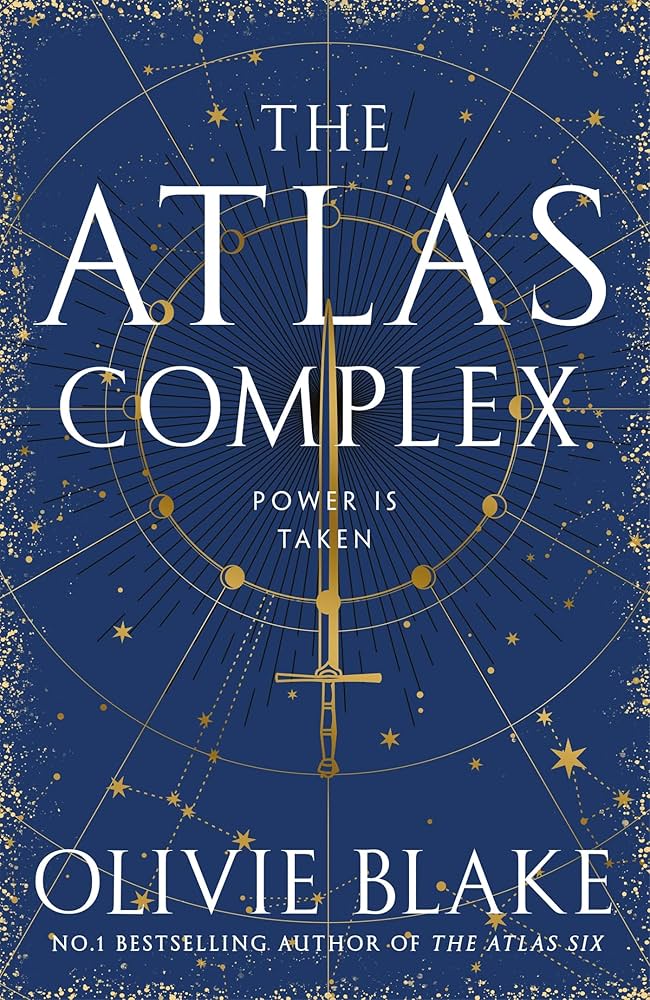
Title: The Atlas Complex
Author: Olivie Blake
Publisher: Tor Publishing Group
Publication Date: 2024
The Atlas Complex is the final book in Olivie Blake’s dark academia series: The Atlas Trilogy.
Following on from book two Complex tracks our six protagonists as they adjust to life post-education. This is all whilst dodging the assassins sent by various tech and magic hungry corporations.
In the outside world, Reina and Callum are trying to change the world by mentally influencing one vote/election at a time. Elsewhere Parisa is trying to find meaning in her life while attempting to control an increasing erratic Dalton whose mind is in fractures. Back within the Alexandrian society buildings, Nico, Tristan and Libby have learnt that together they may have the ability to open a wormhole to a parallel universe – but can they agree to work together?
The series continues to be a blend of a modern fantasy world where magic is as respected as science, a dark academia core setting, and philosophical debates between the characters. Now that I’m at the end of this series my feelings are leaning more towards liking this combination rather than loving it; but I have to praise Blake for keeping her writing style and unique feeling of this series consistent across all three novels. It is definitely a fantasy series unlike any I’ve read before with its focus on the thought processes of its characters before their actions or dialogue.
Normally in a book series my favourite character/s stay the same from book to book however in The Atlas Complex I once again found myself changing to a different favourite. This time it was Callum and Parisa’s chapters that I found myself looking forward to the most. Both characters felt quite proactive in their choices as they looked forward to the future and wondered what it could look like for them after two years of being sequestered away at the Library. Their emotions (and as a result their driving force) came through a lot clearer in this novel than in previous instalments.
As for my least favourite character, I was very surprised by how much I disliked Nico in The Atlas Complex. Upon hearing that the antagonist Ezra and the elusive Atlas had an evil plan to travel to another world and likely destroy this one in their wake…Nico is immediately convinced that the villains’ master plan is a wonderful idea. After all, he’s powerful enough to open the wormhole so why waste his potential? And what proof do they really have that this experiment will destroy the world? But Nico knows he cannot do this task alone and spends the majority of the novel harassing Parisa and Reina via text/chat as he begs them to return to the society to help him.
Nico is annoying and immature at best in this novel and it made me wonder – has he always been this way and I just haven’t noticed before? In The Atlas Paradox he does indeed spend much of the story pestering the others; but this is to rescue Libby from Ezra’s clutches. Here his motivations were selfless and it showed the strength of his friendship with Libby as he refused to give up on her. But when these same character traits are focused on a selfish pursuit, coupled with Nico’s inability to understand the word ‘no’ he is transformed into a character I sadly found insufferable throughout the entire novel.
So, as the final book in the trilogy, how does The Atlas Complex do as a closing act?
The story manages to build on the existing tensions between the group as their life choices pull them in different directions which helped to create a lot of interesting interactions. These character dynamics were my favourite part of the book. In another positive we also get a conclusion to Atlas and Ezra’s schemes as well as the plotline concerning the group of jaded radicals that have been hunting the six protagonists since the first book.
Where I feel The Atlas Complex falters is the conclusions provided to its main characters. The abrupt endings to some characters and the ambiguous ending to others left me feeling both disappointed and unsatisfied. It also meant that the character development from the first two books felt wasted with a few, like Reina, feeling woefully underused and others, like Libby, making choices that felt out-of-character.
So unlike the previous books, The Atlas Complex was a very mixed affair. There were parts I liked and parts that I really didn’t. Despite some great character interactions, especially between Callum/Tristan and Reina/Parisa, unfortunately I would say that this is the weakest book in the trilogy. Nevertheless The Atlas Complex and The Atlas Trilogy as a whole is an interesting experiment in storytelling and completely unlike any fantasy series I have previously encountered.
Related Posts:
If you enjoyed this review then you may also like these reviews: