
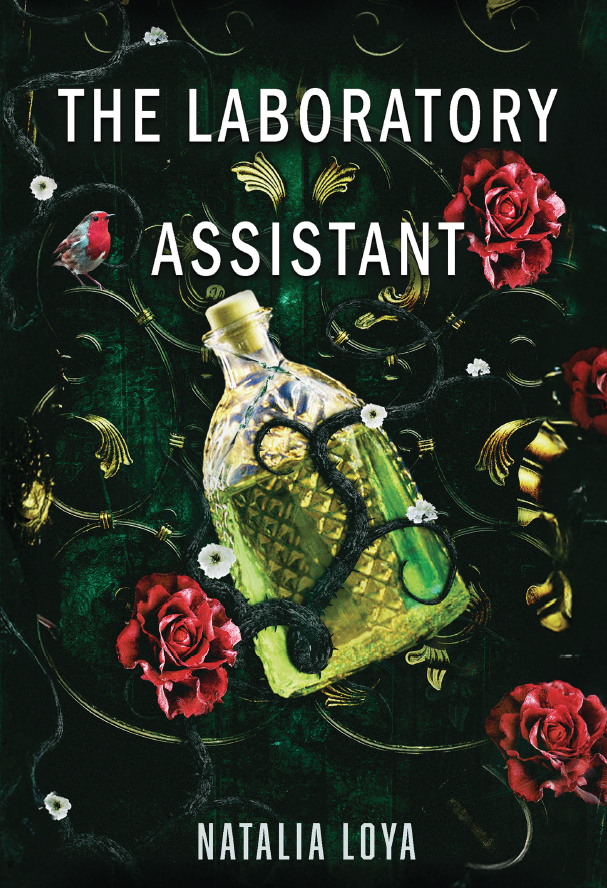
Title: The Laboratory Assistant
Author: Natalia Loya
Publisher: Apprentice House Press
Publication Date: 2026
CONTENT WARNING: The Laboratory Assistant includes scenes that deal with the aftermath of rape and sexual assault. It also includes scenes of human experimentation.
The Laboratory Assistant is the debut novel by Natalia Loya. It is primarily a historical fiction with elements of romance and gothic horror.
The story starts in Petrograd, Russia during 1916 and focuses on the Sokolov family. The family consists of three sisters and their sick mother who are still adjusting to the sudden loss of their father during the war and his secret gambling debts that have left them impoverish. Our protagonist is the eldest sister – Mariya. At twenty years old she is in charge of the family’s finances and the sole breadwinner for the family. She eagerly switches working in a shoe factory for a role assisting Dr Nikolas Rodin in his laboratory. Rodin is a scientist attempting to find a cure for consumption (tuberculosis). Over the course of the novel Mariya finds herself drawn to both the enigmatic Dr Rodin and his increasing dark experiments.
The Sokolov sisters are the heart of this novel and they are why the story works so well. Much of the story is a tale about an everyday struggle for survival. Mariya runs the family while the eighteen year old Sofia attends secretary classes. Sofia’s involvement with the Bolsheviks caused complications for the family but she is fiercely protective of her sisters. By the start of the story they have both sacrificed their dowries in favour of food and basic supplies – and all to protect Darya, their eight year sister and the embodiment of innocence in the novel, from having to do the same.
Even though the family are fallen aristocrats, at no point do the sisters act entitled or snobbish towards others. While they lament the possessions they have lost, like Sofia’s piano, their attitude is one of making the best of a bad situation and being grateful for their friends and any opportunities that come their way. This makes the family incredibly likable and from beginning to end I found myself caring about them, worrying about their plights and hoping they would succeed.
One aspect of the story that I really liked was that Mariya and Sofia’s intelligence was never mocked or questioned by the male characters; quite the opposite. I’ve read several historical novels where one of the key plot points involves the female protagonist being forced to hide her intellect. While The Laboratory Assistant does highlight the difficulties facing this family with no living male relatives, Mariya and Sofia’s knowledge, learning and reasoning was always respected and encouraged by their peers.
The character of Dr Nikolas Rodin straddles the line between anti-hero and villain. Both his desire and motivation behind wanting to find a cure for consumption comes from a good place but his methods become increasing dark as he moves onto human experimentation. The novel stresses both Rodin’s love for Mariya and his internal battle with mental illness as the reasons behind his ability to perform his ghoulish experiments without guilt. While for me it didn’t affect my enjoyment of the book, I do wonder how the story and Rodin’s relationships would have played out if Loya has chosen instead to make the character carry out his experiments in spite of his illness rather than because of it.
A creative choice I did find odd was to frequently have Mariya called by her full name during dialogue when other characters are not address in the same way. Also, during sections of prose, characters are often referred to by common nouns rather than their names – for example Mariya and Rodin become: ‘the assistant and the scientist’. While these choices felt a bit overdone by the end of the novel they didn’t affect my reading of the story,
I’m unsure if the book is perfect in terms of its historical accuracy or whether the language always exactly matches the time period, but Loya without a doubt creates a vivid picture of an uncertain homelife during a period of great change for Russia in the early 20th century.
The Laboratory Assistant is an excellent debut novel by Natalia Loya. It is filled with engaging characters, a slow-burn believable romance, a brooding gothic atmosphere and suitably macabre scenes during the climax. The pacing of the story was really good and the novel kept me wanting to read more.
An Advanced Reader Copy of ‘The Laboratory Assistant’ and the images used in this review were kindly provided by Mindbuck Media Book Publicity. For more information check out their website including further details about ‘The Laboratory Assistant‘.
Related Posts:
If you enjoyed this review you may also like these reviews: