
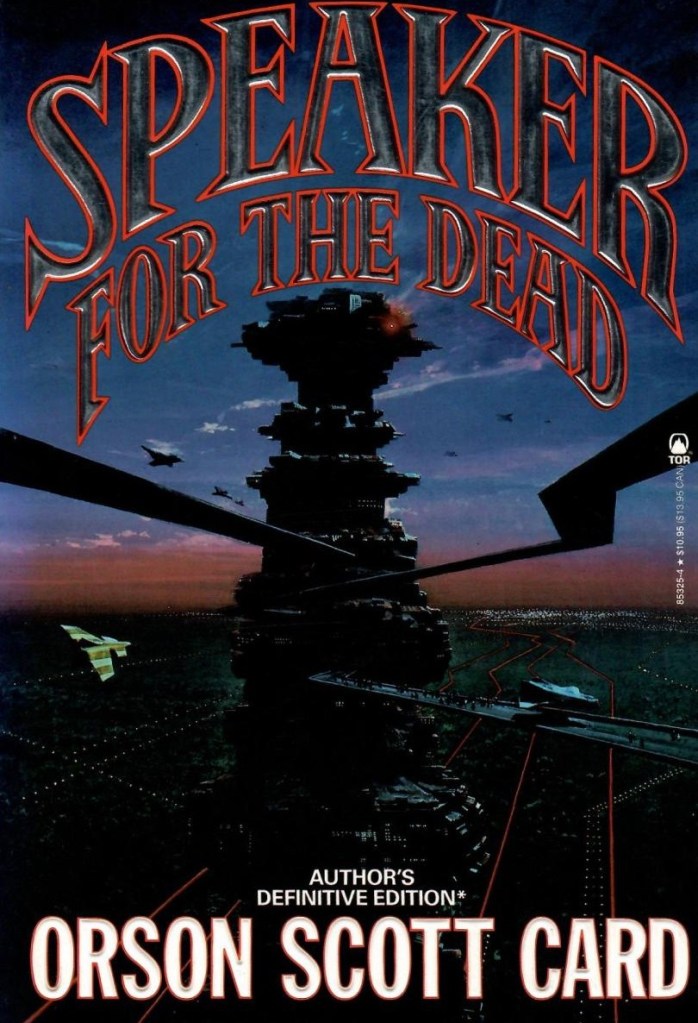
Title: Speaker for the Dead
Author: Orson Scott Card
Publisher: Arrow
Publication Date: 1986
Speaker for the Dead is the sequel to Orson Scott Card’s first novel Ender’s Game. Despite its hype, I was disappointed by Ender’s Game and the only reason I gave Speaker for the Dead a chance was because I picked up a copy of both books at the same time. Before I started Speaker I was fully expecting to DNF the novel after a couple of chapters. How wrong I was.
Speaker, set 3000 years after its prequel, has considerably more world building, detailed characters and complex inter-character relationships, an interesting plot with an intriguing mystery and plenty of believable emotional moments. Unlike with Ender’s Game, I cared about what happened to this new group of characters and I continually wanted to keep reading to find out what happened next.
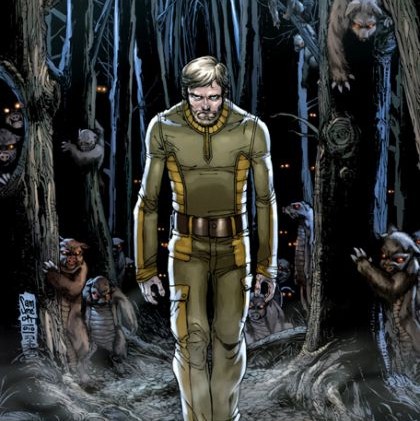
The novel focuses on the lives of two families with an interconnecting history and it is set within the sole human colony on Lusitania. The planet is home to the Pequeninos – a pig/wild boar like group of creatures and the only known intelligent lifeforms besides humans. When two of the colonists are brutally murdered by the Pequeninos a Speaker for the Dead is requested tell their stories. The nearest Speaker is Ender Wiggin (whom history now refers to as Ender the Xenocide) but he is 22 years away from Lusitania and a lot can change in that time…
Whereas Ender’s Game was primarily action driven, Speaker for the Dead is a lot more character focused. This decision led to a more thought provoking novel with an empathise on character interactions – such as the conversations between Ender and Novinha’s children as he helps them to understand the trauma the household has experienced through each other’s points of view.
For Ender and his sister Valentine only fifteen or so years have passed since they set out on their journey to find a new home for the alien Hive Queen but for the rest of universe it has been 3000 years. Time dilation is used to great emotional effect within the story. Valentine had just started a family so the pair agree for Ender to travel to Lusitania alone – knowing that Ender will essentially jump forward in time by two decades while Valentine naturally ages. This personal sacrifice is one of Ender’s motivations – if he succeeds in bringing harmony to Lusitania and fulfilling his promise to the Hive Queen then the siblings loss will have been worthwhile.
A common theme in the novel is that nothing is as it first seems. Card ensures that there is always more than one explanation for why everything happens – from why the colonists are murdered, to why Novinha’s children act the way they do, to how Pequeninos culture truly operates. All of this culminates in a more philosophical story as Card explores human behaviour and challenges our way of thinking. These explorations and analysis really made the story interesting however I did find the inclusion of and defence of Novinha’s abusive husband a step too far on this analytical path.
I had two major criticisms of Ender’s Game: the language of the child characters in relation to their age and the portrayal of the female characters. So how did Speaker for the Dead fair?
Fairly quickly I could tell that the age versus language issue seemed to have been addressed. In terms of dialogue there is no real distinction between the younger and older characters in Card’s novels but, by making the majority of the younger characters either teens or young adults, their language and behaviour felt more age appropriate.
While there are more male to female characters (especially if you count the Pequeninos) the ratio was a lot more balanced and the female characters were given greater roles within the story – from conducting their own investigations to making decisions about the future of the colony. Although I was disappointed Valentine was largely absent from Speaker, it did make narrative sense to isolate Ender from her.
Two characters who I thought could have been improved upon where Novinha and Jane.
We first meet the orphaned Novinha as a teenager. After her parents deaths she becomes cold towards others but across the first chapter we see her grow and learn to make friends. From this initial set up I had expected her to be one of the story’s protagonists but this was not the case. When Ender arrives years later Novinha’s character development has been reversed and she is once again cold and unfeeling. Despite being one of the most discussed characters, this older Novinha instead acts a plot device – a mystery for others to unravel – rather than taking an active role within the story. She had a lot of potential as a character and I wish Card had chosen to develop her further.
In contrast Jane does play an active part within novel. Bound within the virtual world, the AI Jane has helped Ender for a number of years. With her unlimited powers and loyal friendship, Jane was the character I most wanted to learn about. But where Novinha is criticised for her lack of emotions, Jane’s tantrum after Ender ignores her triggers her to set off a chain of events that cause irrevocable harm to the inhabitants of Lusitania. Like with Novinha, I feel Jane had so much potential. I know her actions where necessary to set up book three but I wish the end result had occurred in a different way.
I knew nothing about Speaker for the Dead before I started reading and I think this lack of expectation and knowledge helped me to enjoy the book more. I liked how Card was able to make Speaker complete distinctive from Ender’s Game and the mystery elements with the story really kept me engaged. Admittedly the novel isn’t perfect but I am now curious enough to want to continue this series in the future.
Related Posts:
If you enjoyed this review you may also like these reviews:



 Lair of Reviews