
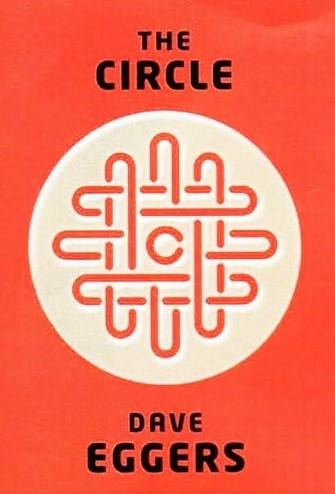
Title: The Circle
Author: Dave Eggers
Publisher: Penguin Books
Publication Date: 2013
When I watched the 2017 film The Circle (an admittedly average film with a good concept but wasted potential) I had no idea it was actually a book adaptation until I stumbled across Dave Eggers’ novel in a charity bookshop. I was really curious to read the original story and see if I liked it better than its film.
The Circle is a contemporary dystopia with an emphasis on social commentary. The story takes an exaggerated look at how the power of social media, human ingenuity, and full transparency in every aspect of life can create the safest society in human history. However this utopia is not a place any of us would want to live, in this 1984-esque novel.
We follow the hopeful and wide-eyed Mae Holland on her first day at The Circle – the most powerful and influential internet company in the world. After Mae escapes her low-paying dead-end job she is understandably excited to join The Circle with its prestigious reputation, impressive salary, and campus-like buildings filled with daily activities and social events for its staff. Naturally Mae is also anxious about losing her position at this prized company if she fails to impress. We watch as Mae gradually loses herself to the ideals of The Circle – first out of fear then due to a determination to become the one of the most influential people on campus.
We quickly see that The Circle and its founders have a cult leader style level of control over its employees. For example, it is stressed to Mae that if she doesn’t attend events at the campus or interact with The Circle’s 10,000-strong online hub then it shows she doesn’t value the company or her co-workers. There are multiple examples of peer pressure and gaslighting within in novel where the fault is always placed on Mae rather than the unreasonable demands of the company. Inevitably The Circle takes over Mae’s life as she spends 20 hours a day either completing work assignments or boosting her online social rankings – even agreeing to go ‘fully transparent’ and livestream every moment of her day.
For me the most interesting part of the novel is the concept that the vast majority of the characters within this dystopian world truly believe they are living in a utopia. For example, The Circle mass produces button-sized cameras which produce their own energy with the idea that, when they are placed all around the globe, people can view any place or site in the world at any time. The Circle members believe that keeping secrets or not sharing all there is to see and know is a crime equivalent to theft. Only a very small number of characters, such as Mae’s ex-boyfriend Mercer, can understand that the company is erasing all forms of personal privacy – especially as the cameras become more and more widespread.
Even though I liked the book overall, just like it’s film adaptation, I kept feeling that the story was lacking something.
In the novel everything happens very easily. Solutions are swiftly found to problems, newly imagined software is developed overnight, and whenever Mae starts to question The Circle she always changes her viewpoint very quickly. When Mae is caught taking a kayak out on the water without permission she readily agrees to go fully transparent to make up for her actions. In fact there are multiple instances where Mae quickly agrees with any counter-argument placed before for. Instead I wish the novel had shown her being punished; cut off from The Circle and starved of social media before eventually being reinstated. This then would have made Mae’s devotion to the company more understandable as she fought to never be in that situation again as well as clearly showing the hold The Circle has over its users.
As well, there were also a few unrealistic details that kept pulling me out of the story. Within weeks of starting Mae and her colleagues all upgrade from a single computer monitor to eight – and they are able to control all them simultaneously with ease. How? Also Mae frequently spends 20 hours a day staring at her screens. This means she gets a maximum of 4 hours of sleep a day yet she is never exhausted and both her eyes and body are in perfect health. I know a lot of Eggers’ novel can be classed at satirical and deliberately exaggerated but for me the best satires are ones you could actually imagine happening – I didn’t always feel this was true of The Circle.
So, is the novel better than its film? Yes. The book finds a good middle ground between moments that keep the story progressing and giving scenes extra details in a way that doesn’t slow the plot down. For example when Mae is being bombarded with online messages, the quicker storytelling of film only allows the viewer a couple of seconds to absorb the information whereas the novel allows readers to take their time and examine some of these online interactions in detail.
However, like its film, the novel isn’t perfect. In addition to the reasons I’ve previously highlighted I feel that the novel was always going to struggle by having a character like Mae as its protagonist. Everything about her journey is deliberate and designed to show she falls under The Circle’s spell. Yet this also makes Mae an intentionally unlikeable character as the story goes on however she never slipped far enough from protagonist into anti-hero for me to start rooting for her to succeed again.
As a fan of dystopias I’m pleased I read the book and satisfied my curiosity however I don’t feel like this is a book I will end up re-reading in the future.
Related Posts:
If you enjoyed this review you may also like these reviews:


 Lair of Reviews